
The Microcosmic Orbit, Vagal Tone, and Your Nervous System

An ancient Taoist meditation that moves attention up the spine and down the front of the body, and what its path has to say about your vagus nerve and your nervous system.
What Is the Microcosmic Orbit?
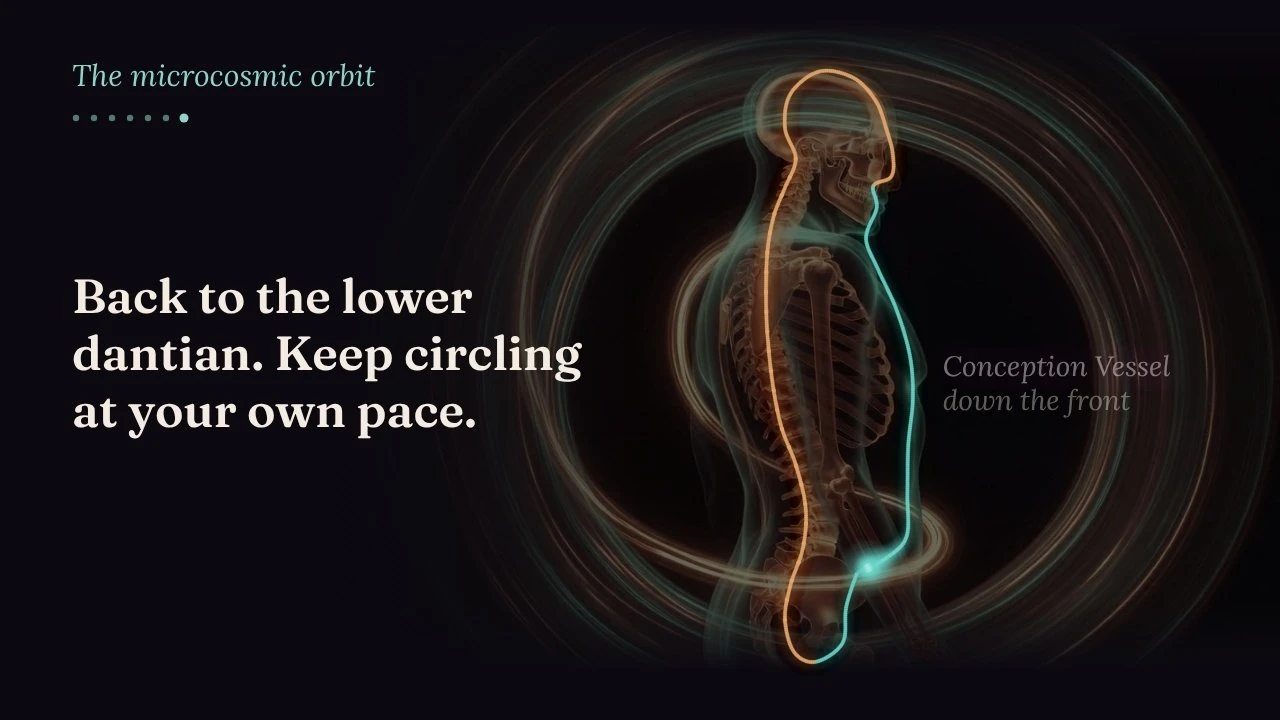
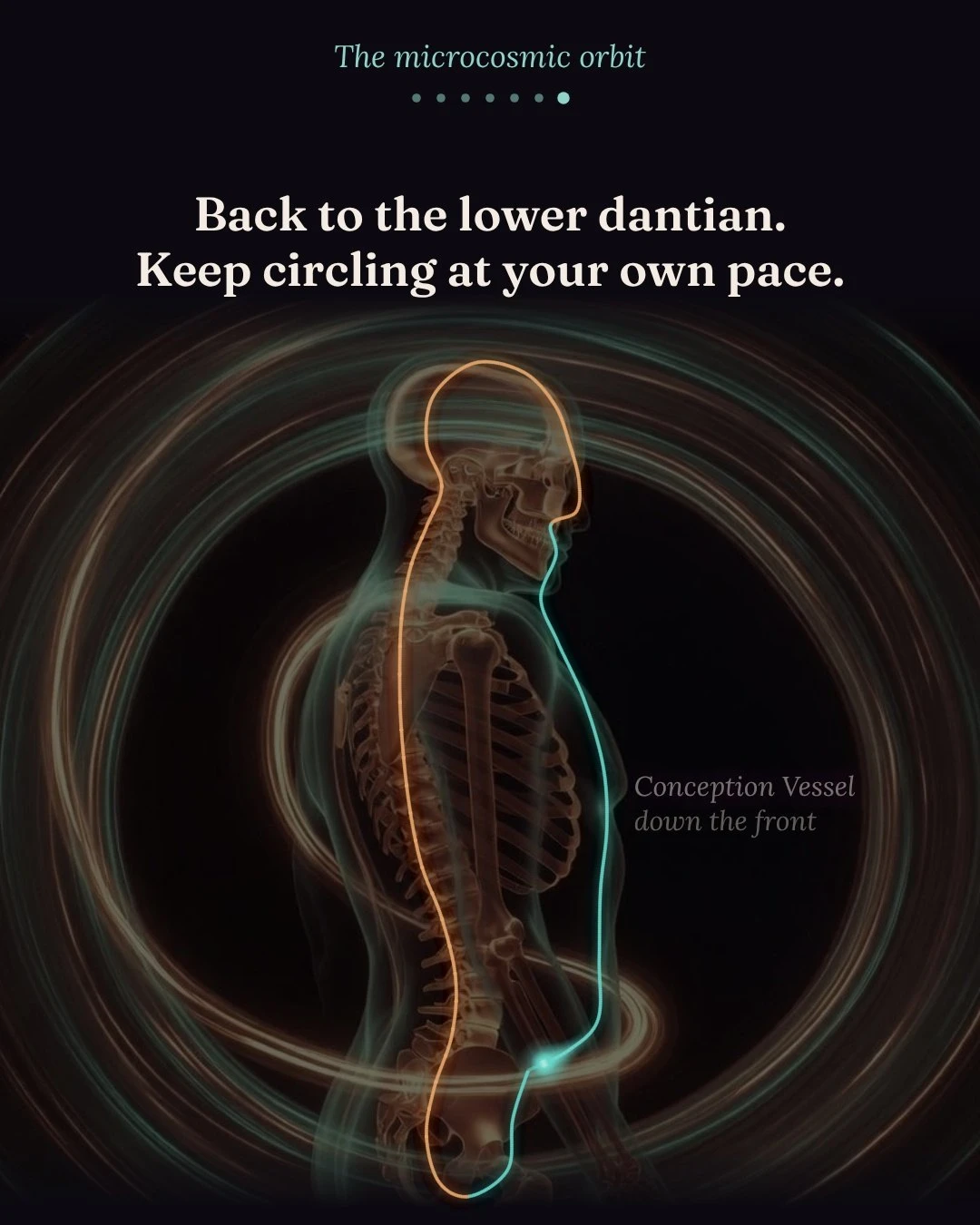
The microcosmic orbit is one of the foundational meditation practices in Taoist internal alchemy. It guides awareness (and what the Chinese tradition calls qi, or vital energy) along two primary channels in the body: the Governing Vessel (Du Mai), which runs up the spine from the perineum to the crown of the head and down to the upper palate, and the Conception Vessel (Ren Mai), which descends from the tongue along the front midline of the body back to the perineum.
Together, these two channels form one continuous loop. You gently circulate attention around it, usually beginning at the lower dantian (about two inches below the navel), traveling down to the perineum, up the spine, over the crown of the head, and back down the front of the body. The tongue resting on the roof of the mouth is the bridge that joins the two vessels and completes the circuit.
The practice has been refined over many centuries. Traditionally it was used to cultivate vitality, strengthen the organs, calm the mind, and prepare the body for deeper states of meditation. What makes it so relevant today is how much of its pathway overlaps with the territory of the vagus nerve and the autonomic nervous system.
Understanding Vagal Tone
The vagus nerve is the longest cranial nerve in the body. It begins in the brainstem and winds down through the neck, chest, and abdomen, reaching the heart, lungs, digestive tract, and many other organs. It is the main nerve of the parasympathetic nervous system, the branch that supports rest, digestion, and repair.
Vagal tone describes how active and responsive the vagus nerve is. Higher vagal tone is associated with a calm, adaptable nervous system, one that can rise to meet a demand and then return to ease without getting stuck there. In research it tends to go along with more flexible emotional regulation, while lower vagal tone tends to show up alongside long-term stress.
Vagal tone is usually estimated through heart rate variability (HRV), the subtle variation in time between one heartbeat and the next. A responsive vagus nerve shows up as higher HRV, the signature of a nervous system that can shift gears. Slow breathing reliably raises HRV while you are doing it, and studies of meditation and breath practice suggest that a regular practice may support it over time.
Where the Orbit Meets the Vagus Nerve
When you trace the path of the microcosmic orbit, the front channel moves through much of the same territory the vagus nerve travels: the throat, the chest, the belly. The back channel climbs the spine, alongside the nerve pathways that help set how alert or at ease the body is.
I find it useful to read the orbit alongside Stephen Porges' Polyvagal Theory, a model many somatic practitioners work with, though researchers still debate parts of it. Porges describes a ventral vagal branch associated with connection, safety, and calm engagement with the world, and a dorsal vagal branch associated with immobilization, shutdown, and deep rest. The front of the orbit, moving through the face, throat, and heart, has much of the quality of that ventral side. The long, quiet climb up the back has the quality of the dorsal side, and when that stillness arrives gently (rather than through overwhelm), it can be deeply restorative.
So by circulating awareness through both the front and the back, the orbit invites you to practice moving between states: engagement and deep rest, activation and calm. You are not just relaxing. You are giving your nervous system repetitions in shifting smoothly from one state to another, and that flexibility is the essence of nervous system resilience.
How the Microcosmic Orbit Supports Your Nervous System
A few things make this practice especially supportive for the nervous system:
1. Slow, intentional breathing. Most versions of the orbit pair it with slow belly breathing. Your heart naturally speeds up slightly as you breathe in and slows slightly as you breathe out, and that slowing on the exhale is the vagus nerve at work. A long, unhurried exhale leans into that rhythm and invites the parasympathetic response.
2. Interoceptive awareness. Guiding attention through different regions of the body builds interoception, your ability to sense what is happening inside. Interoception is closely tied to emotional regulation: when you can feel your internal state clearly, you have more room to respond to stress rather than react to it.
3. Attention along the spine. The climb up the back passes alongside nerve pathways that help regulate the body's level of alertness. Slow, gentle attention along this route often brings tension held in the back body into awareness, and what you can feel, you can begin to soften.
4. The tongue on the palate. Resting the tongue on the roof of the mouth, a hallmark of the practice, brings sensation to an area rich in cranial nerve endings and tends to soften the jaw and throat. Many people find this simple gesture settles them surprisingly quickly.
5. Linking upper and lower centers. The orbit connects the head (upper dantian) with the belly (lower dantian), echoing the gut-brain connection the vagus nerve physically carries. Circulating awareness through both may support a clearer felt sense of how the two communicate, a conversation that plays a part in mood and digestion.
A Simple Way to Begin
You do not need years of training to explore this practice. Here is a gentle starting point:
- Sit comfortably with your spine upright but not rigid. Close your eyes and take a few slow breaths to settle in.
- Place the tip of your tongue gently on the roof of your mouth, just behind the front teeth.
- Bring your awareness to the lower dantian, the area about two inches below your navel and an inch or two inward. Rest your attention here for several breaths.
- Slowly guide your attention downward to the perineum, then up along the spine, one vertebra at a time, to the crown of the head.
- From the crown, let your attention descend down the front of the face, throat, chest, and belly, returning to the lower dantian.
- Continue circulating at your own pace. There is no need to force anything. Let the breath and the awareness move together naturally.
Start with five to ten minutes. Over time, you may notice a deepening warmth, a settling of the mind, and a palpable sense of the body calming itself from the inside. Sensations like these are common in slow, inward practices, and they are often a sign that your system is shifting toward rest. If any part of the loop feels like too much, simply rest your attention at the lower dantian, or open your eyes and leave the practice for another day.
Ancient Wisdom, Modern Nervous System Science
The Taoist masters who developed the microcosmic orbit did not have the language of vagal tone, polyvagal theory, or heart rate variability. But they were mapping the same territory. Through direct experience and centuries of observation, they found that circulating awareness through the body in this pattern calmed the mind, steadied the body, and strengthened the practitioner's capacity to remain centered under stress.
As nervous system research keeps pointing to the value of vagal health and flexibility, the microcosmic orbit stands as a remarkable example of a contemplative practice that was paying attention to the same things long before science had words for them. It is not just meditation. It is a direct, embodied way to work with a nerve that plays a central role in your capacity for calm, connection, and resilience.
I weave elements of the microcosmic orbit and vagal toning into my sessions, through Capacity for Self Breathwork™, which threads through all of my work, and Capacity for Self Bodywork™, where hands-on work and breath meet. Sessions happen in my studio in Cotati or as mobile sessions across Sonoma County.
Ready to Start Your Healing Journey?
Start with a free 15-minute phone call. We talk through what you are looking for and whether this work is a good fit, with no commitment either way.