
The Bridge
Capacity for Self Breathwork™
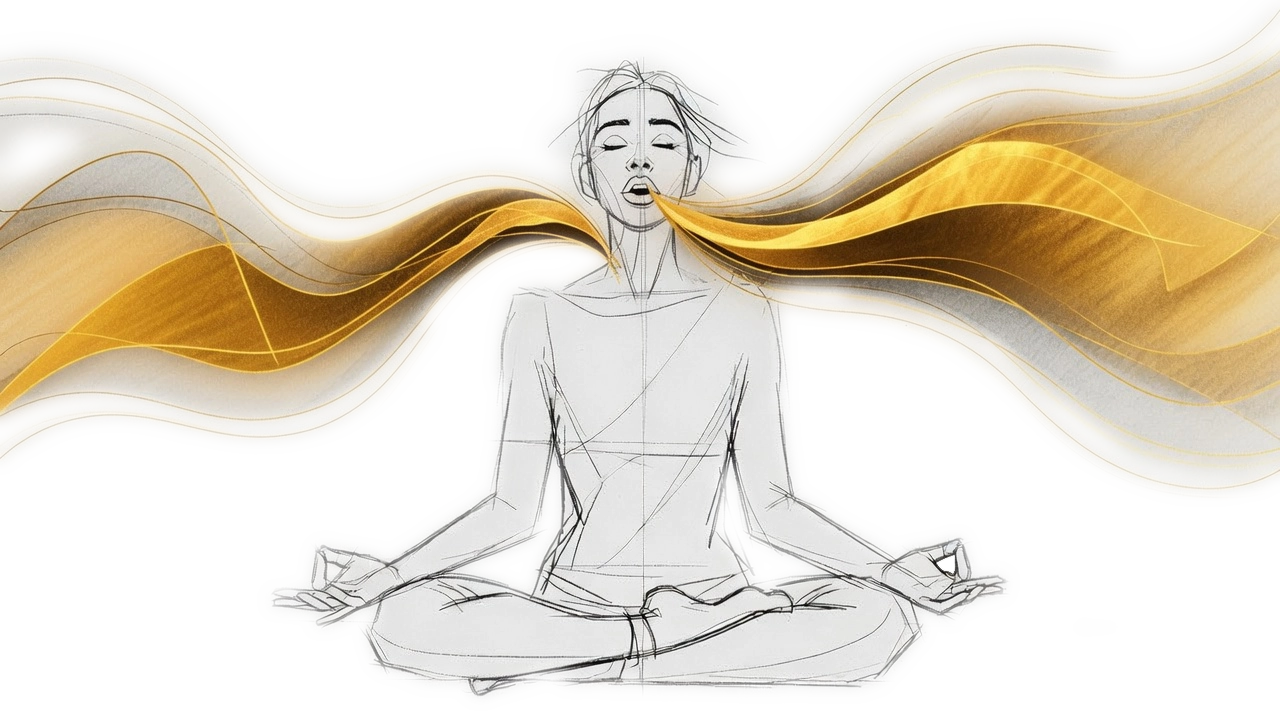
Of all the systems running inside your body right now, only one straddles the border between voluntary and involuntary: the breath.
Your heart beats without your permission. Your digestive system processes food whether you think about it or not. Your immune system fights infection while you sleep. These are autonomic functions: the body's operating system running in the background, beyond the reach of conscious choice. The breath is different. It breathes itself when you are not paying attention, and the moment you choose to pay attention, you can change it.
This makes the breath the only bridge between what you can control and what runs on its own. Between the conscious mind and the body's involuntary systems. Between the Survivor Self's territory and the Young Self's domain. Between intention and physiology. In the Capacity for Self Method™, this bridge is not incidental. It is structural.
“The breath bridges every modality, connecting tissue release with emotional processing, energetic shifts with awareness, and physical sensation with meaning.”
The Architecture
Why Breathwork Is the Bridge
Capacity for Self Breathwork™ is one of the two companion practices of the Method, and the one that runs through every pillar session. It does not address only the mind, only the body, or only the spirit. It touches all three simultaneously, which is what makes it the bridge.
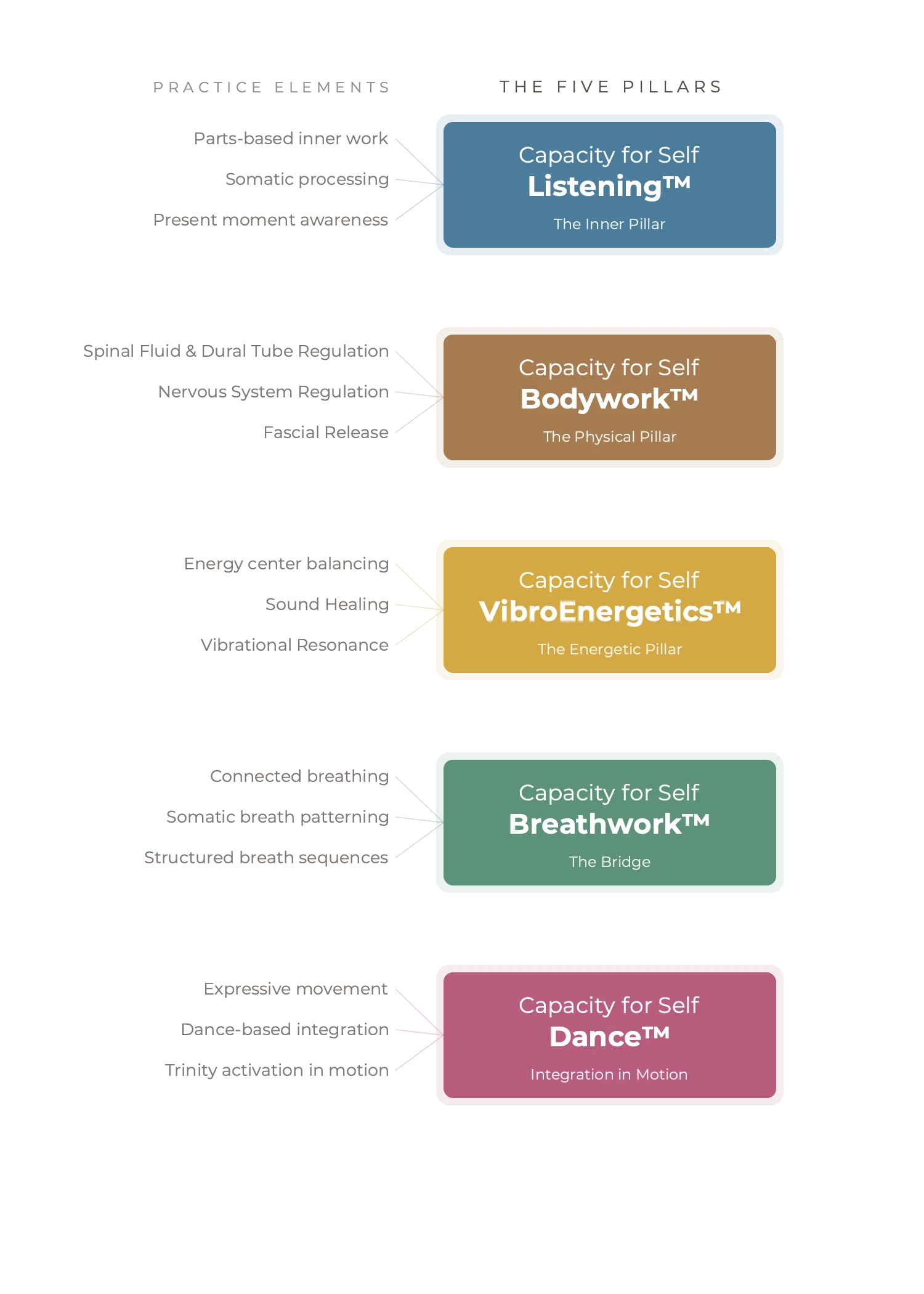
The Trinity-anchored pillars each have a primary domain: Capacity for Self Listening for the Survivor Self, Capacity for Self Bodywork for the Young Self, Capacity for Self VibroEnergetics for the True Self. Capacity for Self Breathwork™ serves whichever of those is active in the moment. It amplifies whatever process is underway. It is the connective tissue of the Method itself: not a destination but a pathway between destinations.
Capacity for Self Breathwork™ stands as its own pillar (taught as a standalone class) and as the bridge that runs through every Capacity for Self Listening, Bodywork, and VibroEnergetics session. Capacity for Self Dance™ takes the same Method and integrates it in motion. Both are accessible to the public without prerequisite training.
Assessment
What the Breath Reveals
Watch someone's breath for thirty seconds and you will know more about their internal state than an hour of conversation could tell you. The breath does not lie. It cannot perform calm while the system is in crisis. It cannot fake depth while the Survivor Self is restricting it. It is the most honest signal the body produces.
When the Survivor Self is running the system, the breath is shallow, rapid, and high in the chest. The Survivor Self has restricted the diaphragm because a full breath reaches into the belly, and the belly is where sensation lives. The Survivor Self learned long ago that restricting the breath restricts feeling.
When the Young Self is activated, the breath catches, stutters, or stops entirely. Breath-holding during emotional activation is the body's way of bracing, the same response an animal has when it freezes in the presence of a predator.
When the True Self is present, the breath is full, slow, and effortless. It reaches the belly without instruction. It moves without restriction. It has a quality of someone who is actually here. Not planning, not remembering, not bracing. Present.
Practice
Breathing Techniques in the Method
Breathwork in the Capacity for Self Method is much simpler than many of the complicated techniques out there. At any given moment in a session, the client is welcome to use whatever breath feels right in the moment to achieve the state their intuition is guiding them toward.
If you are over-activated and want to feel calmer: deep, slow breaths will bring the system down.
If you are too calm, numb, or slightly disconnected and want to feel more awake: more active and energizing breaths will bring the system up.
The breath I return to most often: a deep, slow breath in, and once the lungs are full, a deep, slow breath out, and once empty, repeat. The breather can move air through the mouth, or through both the mouth and the nose, but definitely not just through the nose. The critical detail is that there is no pause between the inhale and the exhale. The breath flows continuously, like a wave rolling in and rolling out without a beat of stillness between them.
Recent popular science has brought renewed attention to nasal breathing. The research is legitimate, and it has helped many people become more conscious of how they breathe. But what matters more than which pathway the air takes is the quality of openness in the system that is breathing. A breath drawn rigidly through the nose because a book said so is not a free breath. The breath is the bridge. Bridges do not have gatekeepers.
Across the Pillars
How Breath Serves Each Pillar
In Capacity for Self Listening, breath creates safety. Slow, deep breathing communicates to the nervous system, in the only language it trusts, that the emergency is over. The Survivor Self responds to physiological signals, not conceptual ones. The breath speaks the Survivor Self's language.
In Capacity for Self Bodywork, breath is the primary release mechanism. As the practitioner's hands hold a fascial restriction with sustained presence, the first sign that the tissue is beginning to release is almost always a change in the breath. The breath deepens. It slows. It may become audible as a sigh or a long exhale. The fascia is letting go, and the breath reflects the change in real time.
In Capacity for Self VibroEnergetics, breath is the carrier of awareness. During sound healing and energy work, guided breathing amplifies the body's ability to receive vibrational input and direct it where it is needed. When a singing bowl rings and the client breathes into the vibration, the effect is qualitatively different from when the bowl rings and the client is holding their breath. The breath is the difference between the vibration washing over the surface and the vibration reaching into the interior.
This work is somatic education and complementary care. Read full scope of practice →
Practice With Wayne
Experience Somatic Breathwork
Breathwork is woven into every session: never as a separate technique, always as the bridge connecting whatever is unfolding. In Sonoma County, California, or virtually from anywhere.
When all else fails, when the theory feels like too much and the techniques blur together: just take a deep breath in and a deep breath out. Slow. Steady. It really is that simple.