
The Physical Pillar
Capacity for Self Bodywork™
Capacity for Self Bodywork works directly with spinal fluid and dural tube regulation, nervous system regulation, and fascial release. The physical pillar of the Capacity for Self Method™. Sessions support those experiencing chronic pain, restricted breath, postural patterns that have not resolved with stretching, and the body's stored stress patterns.
The practice synthesizes cranial sacral therapy and myofascial release with proprietary fascial techniques into a single, continuous conversation with the body's own intelligence rather than discrete techniques applied in sequence.
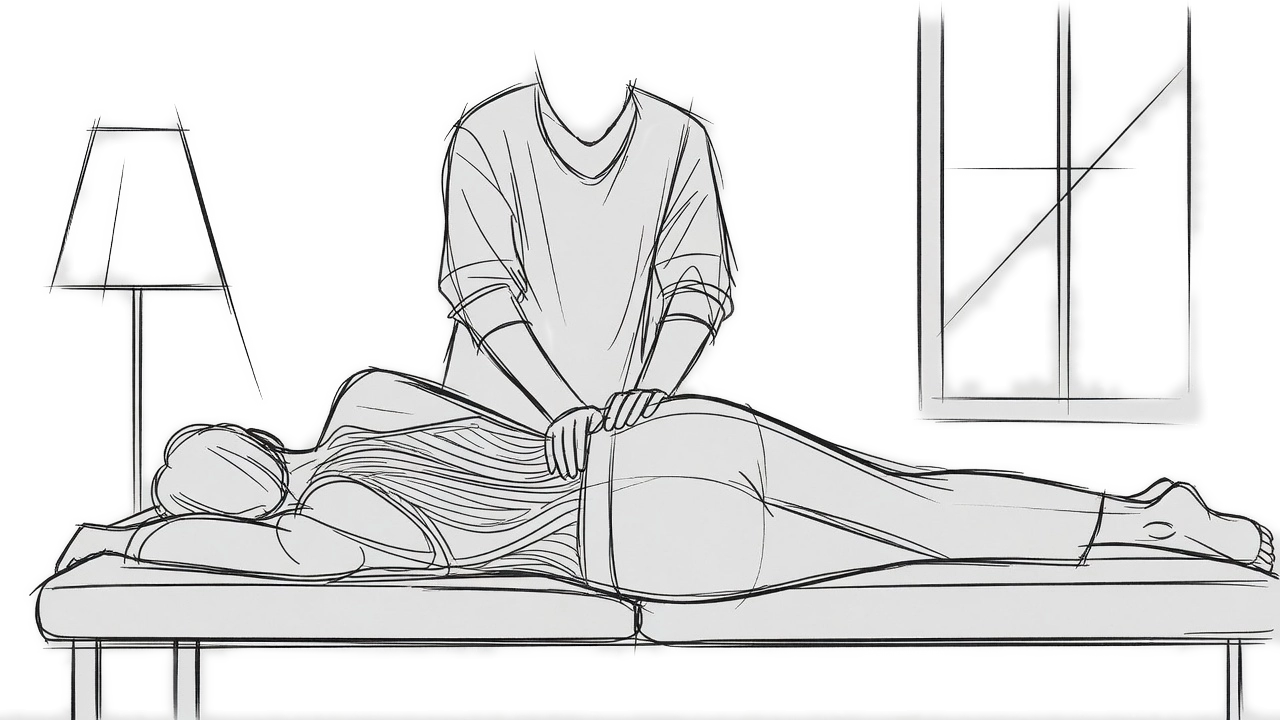
No oil, no rhythmic movement, mostly stillness. The practitioner's hands meet the tissue at the barrier between resistance and invitation, hold with sustained patient pressure, and wait for the body's own release. Sometimes the deepest releases come from the lightest touch.
“The fascial web is the body's autobiography. Every restriction tells a story from the past that the tissue is still holding.”
The Pillar
The Body Is the Past Made Physical
The body remembers what the mind cannot. Every restriction in your fascia, every holding pattern in your tissue, every place where your breath cannot fully reach is a moment from your history that was never fully completed. The body is the past made physical, and Capacity for Self Bodywork is the pillar that works with that record directly.
Who this is for. Clients whose pain has outlasted any clear cause. Clients carrying chronic tension, restricted breath, postural patterns that no amount of stretching has resolved. Practitioners who want to integrate cranial sacral work and myofascial release into a single coherent approach grounded in the Capacity for Self framework.
What a session looks like. The body sets the agenda. There is no predetermined sequence of areas to address, no checklist of restrictions to release. The practitioner reads what the body is showing (temperature, density, breath, the cranial sacral rhythm) and follows. Sometimes the trail leads somewhere unexpected: a neck restriction traces through fascia to the ribcage, to the diaphragm, to the psoas, to a deep pelvic holding pattern that has been there since childhood. The client came in for neck pain and the session ended up addressing something far more foundational. This is not the practitioner going off-script. This is the body revealing its priorities, which are often different from the mind's priorities.
The Principle of Non-Violation. The nervous system does not respond to force with openness. It responds with more guarding. Capacity for Self Bodywork meets every restriction at the barrier between resistance and invitation, holds at that edge with patient presence, and allows the tissue's own response to determine the pace. Force produces compliance. Softness produces release.
Integrated Modality
CranioSacral Therapy
Cranial sacral therapy is one of the foundational modalities Capacity for Self Bodywork integrates. It is gentle, relaxing, highly impactful, and subtle. It does not use oil or lotion and takes place directly on the skin or through clothing depending on the area of the body that needs attention.
The skull is in constant subtle motion: a pumping, almost liquid breathing of the cerebrospinal fluid that maintains steady pressure around the brain and along the spinal cord. The cranial component of this work helps that movement be as flowing as possible, by softening the tension in the membranes that lie beneath the skull bones and along the spine. When that membrane softens, the entire cranial sacral system settles, and the nervous system shifts from its guarded, alert state into something softer and more receptive.
What this work supports: Back, neck, and jaw tension. TMJ and pelvic discomfort. Anxiety and stress. Headaches and migraines. Nervous system sensitivity. Chronic fatigue. Sleep disruption. Post-concussion sensitivity. Focus and overwhelm. PTSD and trauma recovery. Scoliosis-related discomfort. Sound and light sensitivity.
Historical note: Cranial sacral therapy as a modern modality was developed by Dr. John Upledger at Michigan State University (1975-1983), building on the cranial osteopathic principles of William Sutherland. My training is through multiple non-Upledger lineages (including mentorship, workshops, and clinical integration), and the cranial component of Capacity for Self Bodywork represents a synthesis of these interconnected lineages alongside the John F. Barnes approach to Myofascial Release.
Integrated Modality
Myofascial Release (MFR)
Myofascial Release (MFR) is the second foundational modality Capacity for Self Bodywork integrates. The work uses gentle sustained pressure on the fascial system to release restrictions, restore motion, and address pain at its origin rather than where it presents.
I am formally certified in the John F. Barnes approach to Myofascial Release. The Barnes approach treats fascia as a continuous, living, three-dimensional web that wraps every muscle, organ, nerve, and bone in the body. Because fascia is continuous, a restriction in one area creates compensatory tension throughout the entire system. A fall you took as a teenager that created a restriction in your left ankle did not stay there. Decades later, you have chronic right shoulder pain and no memory of the fall. The past did not disappear. It migrated. Capacity for Self Bodywork follows that migration.
What this work supports: Back and neck pain. Pelvic pain. Whiplash and post-injury recovery. Sports injuries. Anxiety and stress patterns held in tissue. Headaches and migraines. Hormonal patterns affected by chronic tension. Chronic fatigue. TMJ. Carpal tunnel. Scar tissue restriction. Scoliosis-related discomfort. Sciatica. Patterns associated with PTSD. Brain trauma recovery (always in coordination with the client's medical team).
Schleip's research (2003 onward) reframed fascia from inert connective tissue to a sensory organ in its own right, with contractile cells, sensory nerve endings responsive to pressure and stretch, and measurable chemical and mechanical changes under sustained restriction. The fascial web is, in a very real sense, the physical record of everything you have experienced. Capacity for Self Bodywork reads that record directly.
The Tools
Traction and Compression
Capacity for Self Bodywork uses two primary tools: traction and compression. They are not opposites. They are complements.
Traction creates separation along a line: drawing two surfaces apart to make space where the body is asking for more room. Applied through three structural gates: skeletal (joints regaining the room they have lost to decades of compression), cranial (smoothing the tension in the membrane beneath the skull bones), and sacral (the bridge between upper and lower body, where a gentle pull sends a signal through the entire nervous system).
Compression creates safety. When a tissue is too guarded to release, gentle inward pressure tells the nervous system: you are held. You are not alone with this. Once compression has communicated that message, traction becomes dramatically more effective. The tissue that would not release a moment ago begins to soften, because it has just been reassured that the release will not drop it into nothing.
The golden rule. Working with the body is not about heavy pressure or light pressure. It is about meeting resistance. Apply traction or compression until the tissue pushes back, and then pause. Five pounds of force on a hip and five ounces of force on the skull look like completely different amounts, but in both places you are doing the same thing: looking for the subtle stop where the body says "I am here." You do not need to break through the door. You only need to lean against it until it opens on its own.
This work is somatic education and complementary care.
Read full scope of practice →
Experience the Work
Book a Bodywork Session
Sessions in person in Sonoma County, California. A complimentary phone consultation helps determine if this work is right for you.
The body sets the pace. The practitioner waits for the body's invitation. What is ready releases. What is not ready waits.