
Vibroacoustic Tables
Built by a practitioner who uses one with clients in his own studio.
The Tables
Tables I build and sell
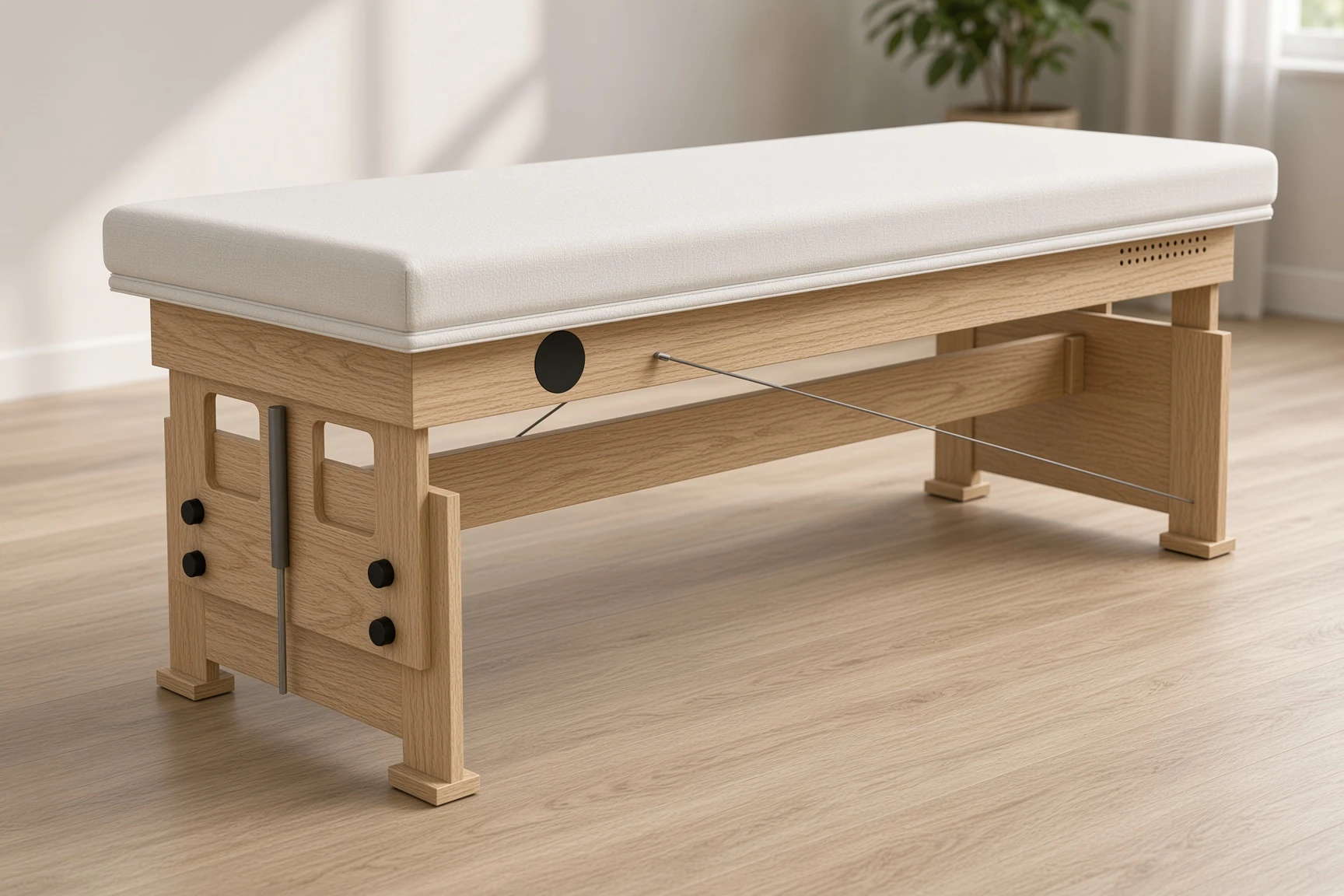
I build and sell vibroacoustic tables, for my own practice and for other people. I have built several models. The one I use with clients in my studio in Cotati, California, is the previous model, and the table on this page is the newest.
The commercial tables I found either fell short or cost far more than they needed to. And I am always curious. I like pushing the envelope, making things work better and, sometimes, reinventing the wheel. So I built my own, and each model has improved on the last.
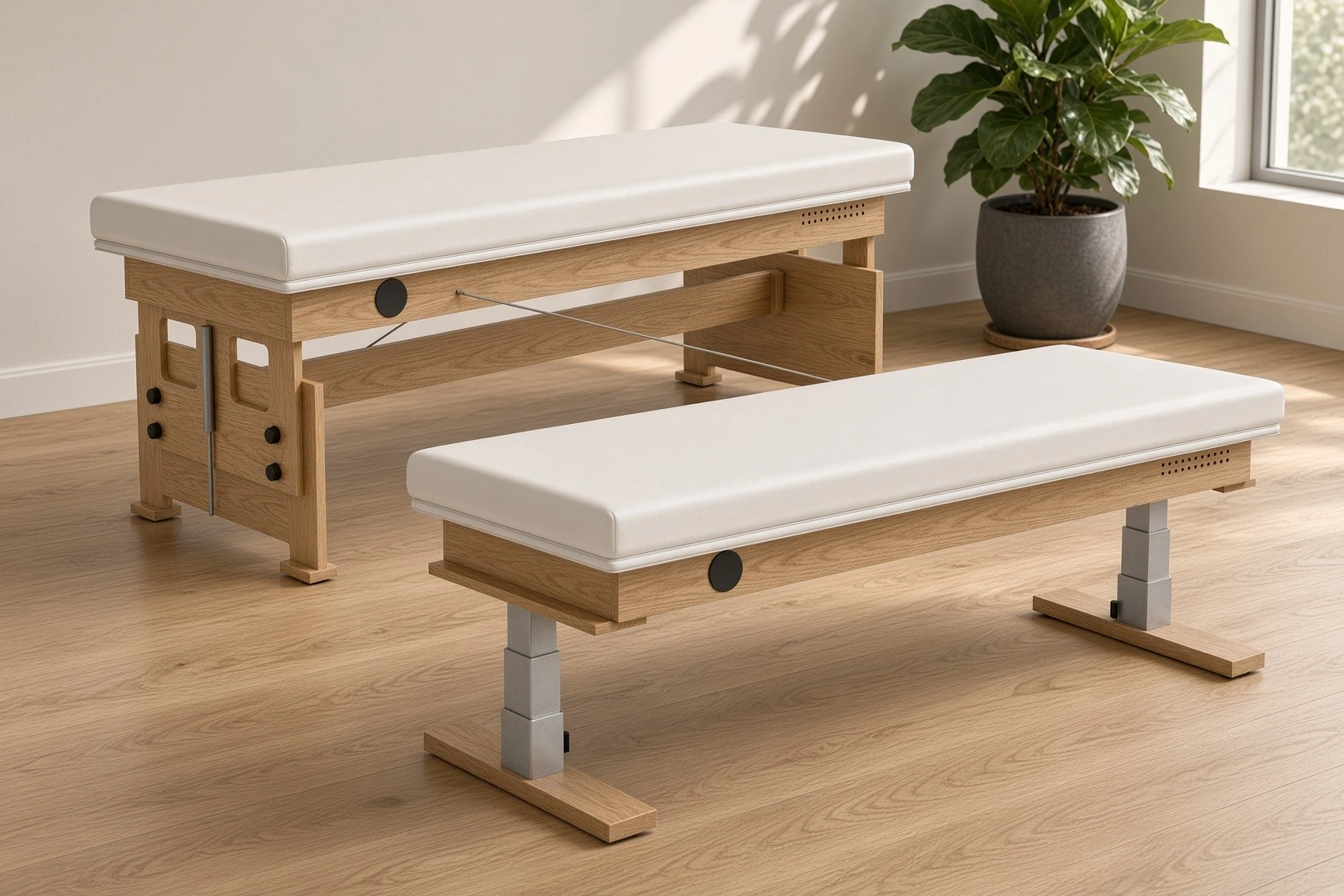
Renderings of the newest model: the standard table on its adjustable legs, and the motorized version.
What It Is
What a vibroacoustic table is
A vibroacoustic table looks much like a bodywork table. The difference is inside it. Transducers built into the table work like loudspeakers without a cone: instead of pushing air, they make the surface itself vibrate. An amplifier drives them from an audio source, playing low tones, music or both, and the vibration travels through the padding and into the body of the person lying on it.
At those low frequencies sound stops being only something you hear. Receptors in the skin and deeper tissue register it as vibration moving through you. The method traces back to the Norwegian educator Olav Skille, who began developing it in the 1980s and first called it a "music bath." His definition used low, rhythmic sound waves mixed with music, slow enough that you feel them as much as hear them. The experience people report most often is a state of deep relaxation (Punkanen and Ala-Ruona, 2012).
In my studio the table is part of Capacity for Self VibroEnergetics™, the energetic pillar of my Capacity for Self Method™, where the table, the bowls, my hands and the breath work as one field. You can book a session on the table to feel it from the inside, and I wrote at more length about what lying on one actually feels like.
The Build
Questions to ask any table builder, and how mine answer
Whether you buy from me or from someone else, these are the questions worth asking. Published specifications vary a great deal from maker to maker, and some of the most useful ones are rarely written down at all. Here is how my tables answer them.
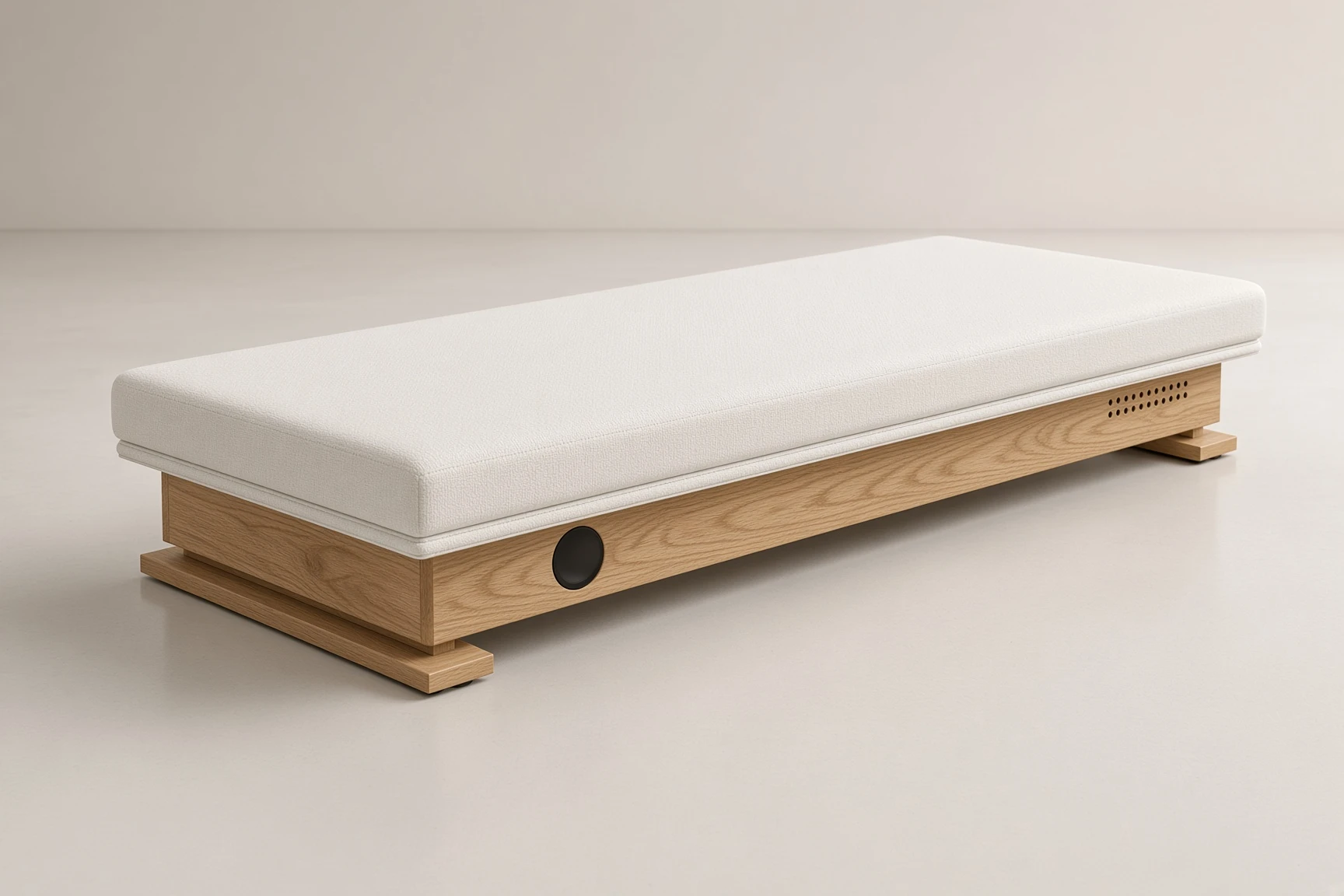
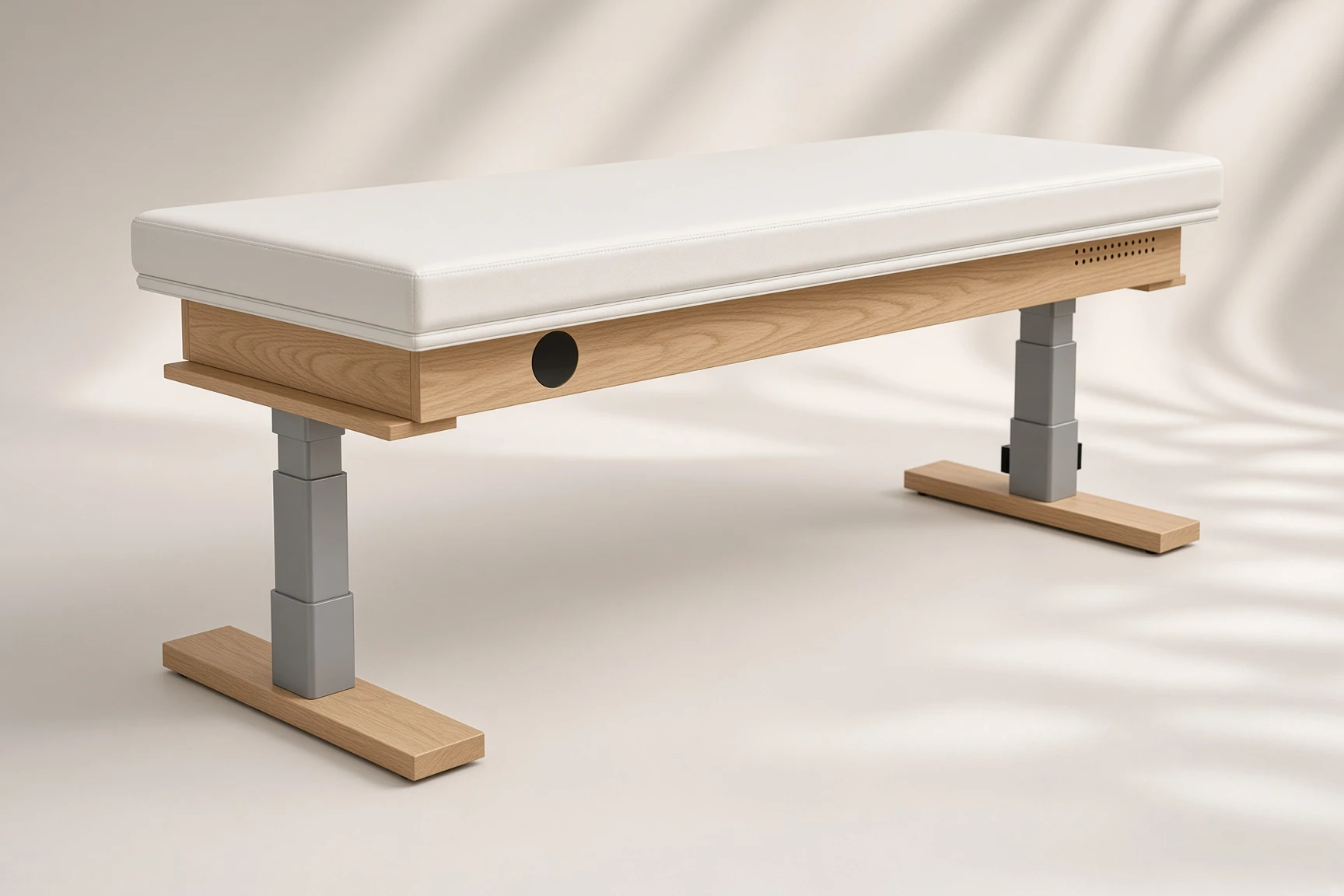
Renderings of the newest model: the standard table on its adjustable legs, the same table on its floor feet, and the motorized version.
At a glance
- Size: 80 x 30 in at the pad
- Height: the standard table comes with both adjustable legs (26 to 32 in to the top of the pad, in 1 in steps, one person, no tools) and floor feet (about 11 1/2 in). The motorized version goes from about 24 3/4 to 36 in at the touch of a button.
- Weight: about 150 lb with the adjustable legs (about 120 lb on floor feet, about 180 lb motorized)
- Designed for: a client up to 500 lb
- Wood: 3/4 in Baltic birch plywood, 13-ply, CNC cut
- Finish: natural Danish oil
- Pad: 4.25 in self-inflating foam, 80 x 30 in
- Vibration: four tactile transducers, under the upper back, the lower back, the pelvis and sacrum, and just below the knees
- Sound: two built-in speakers near the head
- Amplification: built-in sound processing, with each of the four transducers and two speakers on its own channel, and about 100 W available to each transducer
- Felt range: 15 to 140 Hz as standard, or up to 200 Hz, set for you before it ships
- Audio in: Bluetooth or a 3.5 mm cable
- Headphone output: yes, with a 10 ft extension, so a client can hear the music while feeling it
- Power: a standard 120 V outlet (the motorized version needs a second outlet for its columns)
- Type: a stationary studio table; the legs, floor feet or motorized lifting columns come off for moving, and on the standard table you can switch between the legs and the floor feet in about 20 minutes
Baltic birch plywood, 3/4 in thick and 13 plies, cut on a CNC router so every part fits exactly. The top sits on a deep plywood box that stiffens it and hides all the electronics. The standard legs at each end are plywood, joined by a beam and braced with steel cables so the table does not sway. The box is fully closed underneath.
Every joint is glued and screwed or bolted. The finish is natural Danish oil, and every edge an arm or hip can reach is rounded and sanded smooth.
The pad is 80 x 30 in and overhangs the wooden top by half an inch on every side, so every edge you can touch is padded. The frame underneath is set in from the edges, the way a massage table is built, so a fitted sheet tucks under the top.
Every standard table comes with two ways to stand it, and you choose. On its adjustable legs the top of the pad sits at 26 to 32 in, in 1 in steps. One person changes it in a few minutes with no tools: loosen four hand knobs at one end, lift (a gas spring carries most of the weight), tighten, then do the other end.
On its floor feet the top of the pad is about 11 1/2 in, for floor-level rest; it cannot sit flat on the floor, because the power socket, fan and audio jacks are underneath. Switching between the two takes about 20 minutes. The motorized version goes from about 24 3/4 to 36 in at the touch of a button or a foot switch, even with a client on the table. There is no face cradle.
A 4.25 in self-inflating foam pad, 80 x 30 in, inflated firm and held flat to the table so it does not slide or buzz. It works well for everything I do on the table, from sound sessions and rest to hands-on work.
Its surface is a soft knit rather than vinyl, so it is used under a fitted sheet. Any 30 x 80 in fitted sheet sold for RV bunks or cots, with a 7 to 8 in pocket, fits, and it tucks under the wooden top so it stays put.
Four tactile transducers, which shake the surface instead of moving air. They are mounted solidly to the underside of the top along its center line, 12 in apart: under the upper back between the shoulder blades, the lower back, the pelvis and sacrum, and just below the knees. That gives an even field of vibration from the shoulders to the knees, with nothing under the head. Each has its own amplifier channel, and their levels are balanced when the table is set up.
Two built-in speakers near the head carry the part of the music you hear rather than feel.
Built-in amplifiers with sound processing, housed in a closed compartment under the foot end. Each of the four transducers and two speakers has its own channel, and each transducer has about 100 W available, far more than it needs, so it never has to work hard. A limiter keeps the transducers and speakers within safe levels.
Small fans keep the electronics cool, including a compartment fan running at reduced speed, and the power supply's own fan only starts if it gets hot, which ordinary session levels should not cause.
Two ways. Bluetooth from your phone or tablet, or a cable into the 3.5 mm input jack under the foot end, from any player.
There is also a headphone output beside it, with a 10 ft extension that reaches the client's head. There is no Wi-Fi or USB port. You bring your own music and tones.
As standard, the transducers are tuned to 15 to 140 Hz, the range you feel as deep vibration, with a gentle cut above 140 Hz so the table hums rather than rattles. The speakers take over above about 120 Hz.
The transducers themselves reach higher, so if you want more of the finer, skin-level sensation in the upper range, I can tune your table up to 200 Hz before it ships. Going higher also brings more audible buzz from the wood, which is why 140 is the standard setting.
About 150 lb with the adjustable legs, about 120 lb on floor feet and about 180 lb motorized. It is engineered for a client up to 500 lb, with every part calculated at twice that to allow for movement. The feet are cushioned and adjustable.
A stationary studio table. It does not fold. The legs come off in about fifteen minutes for moving, and it ships in three boxes, shipping within the US included: the table in one carton, about 81 x 31 x 8.5 in and about 118 lb packed; the legs and floor feet together in a second (on the motorized version, the lifting columns); and the pad in a third.
It is built not to. The transducers are mounted so they cannot work loose, the frame is glued and bolted, and the legs are braced, so it cannot rack, and the pad is held flat so it cannot lift and buzz.
Rubber-cushioned feet keep the vibration in the table rather than in the floor, and each foot adjusts to stop any rock on an uneven floor. With four transducers spaced 12 in apart, the vibration is even from the shoulders to the knees rather than strong in two spots.
A standard 120 V wall outlet. The cord plugs into a fused, switched socket under the foot end, where a sheet never covers it. The power supply and the socket are UL-recognized components, the power supply is grounded, and every part carrying wall voltage sits behind a closed panel. The table as a whole is not UL or ETL listed, because each one is built in my workshop rather than in a factory. The motorized version has a second cord for the columns. For a table going outside North America, I set it for 230 V before it ships (on the motorized version, the column control box is ordered for 230 V as well).
The table with its electronics installed, tested and programmed; both the adjustable legs and the floor feet, with levelling feet fitted (the motorized version comes with its lifting columns, hand control and foot switch instead); the pad with its hold-down strips; a 10 ft headphone extension; a power cord, a spare fuse and a plain-language setup sheet. Sheets, headphones and music are not included, but I am glad to point you to good sources for music and tones.
Who It Suits
Who the tables are for
I build them for practitioners adding table work to a practice, for studios, wellness and retreat centers, and for people who want one for their own rest at home.
Orientation is included: in person if you pick your table up in Cotati, by video if it ships. I walk you through setting levels, choosing what to play and getting the most from the table in your own work.
Try It First
Lie on one before you decide
The surest way to know whether a vibroacoustic table is for you is to lie on one. Book a live table demo in my studio in Cotati, on the previous model I use with clients. It is a real 30-minute session for $60: about 5 minutes to say hello before you get on the table, about 15 minutes on the table, and about 10 minutes afterward to check in and talk about what is next.
You can also book a full session on the table, with crystal singing bowls, and feel what low-frequency vibration does from the inside.
Ordering
Price, timing and getting it home
Price
Payment
Lead time
Pickup and delivery
Warranty
Cancellations and returns
Buying Well
What a builder says a table does
Two more questions belong on any list. Can I lie on one before I buy? And what does the builder say the table does?
That last one matters. A vibroacoustic table is built for deep rest and resonant sound work, and I describe mine in exactly those terms. I will not tell you a table fixes anything. What I will tell you is how mine are built, how they feel to lie on and how I use one in my own work.
Questions
Questions people ask
I build in small batches, so sometimes a table from the current batch is ready sooner. Otherwise, expect about 4 to 6 weeks from order, plus shipping time.
Yes. Book a live table demo in my studio in Cotati: a real 30-minute session for $60 on the previous model I use with clients. You can also book a full table session.
Every table is built the same way, to one design. There are two versions: the standard table, which comes with both adjustable legs and floor feet, and the motorized table.
No. I build complete tables only.
Send me a message with the inquiry form on this page with what you have in mind and where you are. If you are nearby, you can book a live demo in Cotati first. Then I send you a written order confirmation (US shipping is already included; international shipping is quoted).
Begin
Ask about a table
If you are thinking about a vibroacoustic table, send me a note here. I am glad to answer questions, talk through what you want the table to do and help you work out whether one of mine is the right fit. If you are nearby, you can book a live table demo in Cotati first.