

The Inner Pillar
Capacity for Self Listening™
Capacity for Self Listening is the inner pillar of the Capacity for Self Method™. It is the practice of attuned listening to your own internal system: to the parts of you that have been keeping you safe, to the parts holding what was too much to feel, and to the part of you that can finally meet both with presence.
It is taught as a self-help skill that any reader can apply to their own life, and as the foundational pillar that practitioners learn to teach others.
If you are familiar with parts-based models of the psyche (Internal Family Systems, Voice Dialogue, the Tamura Method, parts-aware Hakomi or Somatic Experiencing), Capacity for Self Listening sits in this broader tradition. What it adds is the somatic dimension: meeting the parts where they actually live, in the body's tension, breath, and posture, rather than only in cognitive dialogue.
“The body holds what the mind has forgotten. The protective parts respond to being met somatically, not analytically. The body opens the door. The mind walks through it after.”
The Pillar
Three Selves in Service of the Body
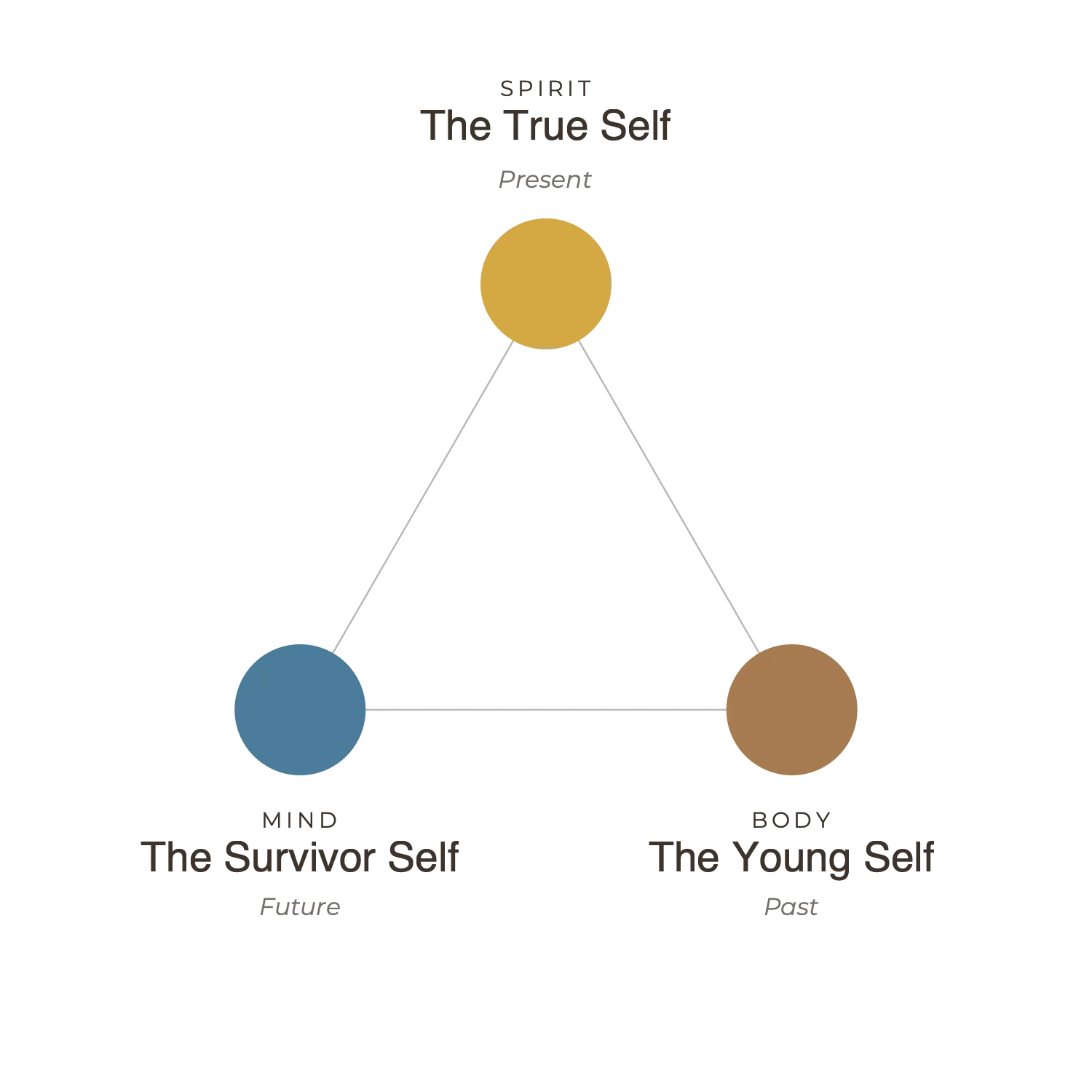
Capacity for Self Listening works with three. Most parts-work traditions identify many inner figures: dozens of subpersonalities, multiple archetypes, layered ego states. Capacity for Self Listening simplifies the inner landscape into three: the Survivor Self (your protective system, all of its strategies (control, planning, vigilance, numbing) gathered into one identity), the Young Self (the wounded, vulnerable parts the Survivor Self has been protecting, which can show up at any age the moment requires), and the True Self (the present-moment awareness that can finally meet both with steadiness).
The reduction is in service of the body. It is impossible to feel the body in relation to twenty parts simultaneously. Three parts can be felt: where the Survivor Self is holding tension, where the Young Self is curling in or shaking, where the True Self enters as warmth and slow presence. The Trinity of Selves is the minimum number that lets the work stay embodied.
Who this is for. Anyone who has felt cognitive insight without lasting somatic change. Anyone who has mapped their inner landscape until it became a cage of consultations rather than a path to freedom. Anyone who has been told their protective patterns are the problem, and is ready to learn that those patterns were the answer to a problem the system could not yet hold.
What a session looks like. Listening can lead a session entirely, or it can serve as the gateway to bodywork or energetic work that follows. In every case, the work begins by honoring the Survivor Self for its service, inquiring (somatically and verbally) what it would need to step back, and waiting for its consent. The Survivor Self is not an obstacle to be overcome. It is a collaborator to be earned.
Integrated Modality
Somatic Parts Work
Somatic Parts Work is the technique-facing name for what Capacity for Self Listening teaches as a practice. It is the lineage that practitioners encounter when they search for "parts work" combined with "somatic," and it is what most clients find when they look for a way out of patterns that talk therapy alone has not resolved.
Traditional parts work, in many lineages, is largely cognitive. You sit in a chair. You close your eyes. You talk to your parts. The therapist guides you through an internal dialogue, and the work happens in the landscape of the mind. For many people, this produces real insight. The problem is that insight and resolution are not the same thing.
Somatic parts work meets the protective system where it actually lives: in the body. The Survivor Self does not exist only in the mind. It expresses its control through the breath you cannot fully take, the jaw that clenches without instruction, the shoulders that ride toward your ears when stress increases, the chronic tension across the upper back that no amount of stretching resolves. These are not muscular problems. They are the Survivor Self holding the Young Self's body in a state of readiness for a threat that is no longer present.
What I have observed across more than 8,000 sessions is that the parts respond to being met where they actually live. A client who is told why their Survivor Self developed has new information, but the part itself remains exactly where it was. A client whose Survivor Self is acknowledged somatically (invited to notice their own breath climbing into the chest, their own jaw setting, their own vigilance scanning the room) is doing something different. They are meeting the part in the layer where it actually lives. The acknowledgment lands. The part feels seen, in its own language, and it begins to soften.
This is why somatic parts work can sometimes accomplish what years of cognitive understanding cannot. The body opens the door. The mind walks through it after.
Lineage & Influences
A Long Tradition
The recognition that the human psyche operates through multiple inner figures has a deep lineage. Indigenous Hawaiian cosmology has long recognized aspects of the self or spirit including ʻuhane (conscious/middle), ʻunihipili (subconscious/inner, tied to body and emotions), and ʻaumakua (higher/ancestral guardian) woven for centuries into hoʻoponopono reconciliation practices and kahuna traditions before Western contact. Plato's tripartite soul (reason, spirit, appetite) and the Buddhist analysis of the five aggregates predate Western psychology by millennia.
In modern times: Sigmund Freud's structural model (id, ego, superego), Carl Jung's archetypal psychology, Roberto Assagioli's Psychosynthesis (1910s), Eric Berne's Transactional Analysis (1960s), Hal and Sidra Stone's Voice Dialogue (1970s), Eugene Gendlin's Focusing, the Tamura Method, parts-aware Hakomi, Internal Family Systems (Richard Schwartz, 1980s).
Capacity for Self Listening sits in this broader tradition while drawing more substantially from somatic and energetic lineages: John F. Barnes Myofascial Release, cranial sacral therapy, Reiki, Jin Shin Acupressure, sound healing, and breath-based awareness practices. The synthesis is mine. The broader inquiry into inner multiplicity is humanity's.
This work is somatic education and complementary care. Read full scope of practice →
Begin the Inner Work
Meet Your Inner Landscape
Sessions in person in Sonoma County, California, or virtually from anywhere. A complimentary phone consultation helps determine if this work is right for you.
Your protective patterns aren't the problem. They were the answer to a problem the system could not yet hold.