Tarot: A Mirror, Not a Fortune
On this page
The Better Question
I want to start by taking something off the table, because I think it gets in the way of what is actually useful here. A tarot card does not tell you what is going to happen. It has no access to your future, no causal line running from a painted image on a piece of cardstock to the events of your life. If you came here hoping I would tell you that the cards can see around the corner of time, I am going to gently disappoint you, and then I am going to offer you something I find far more interesting.
Because here is what I have found, after years of working with people in their bodies and watching how they come to know themselves: most of us are not actually missing information about our lives. We already half-know the thing. We know the relationship is asking us a question we keep dodging. We know the work has gone quiet inside us. We know the grief has not finished moving. What we lack is not knowledge. What we lack is permission, and a way to say it out loud where we can finally hear ourselves.
That is what a good tarot reading does, when it is honest about what it is. It does not answer your question. It asks you a better one. It puts an image in front of you that is just ambiguous enough that you have to lean in, and in the leaning, you reveal yourself to yourself. The card becomes a mirror. And a mirror, used well, is one of the most respectful tools I know, because it never tells you who you are. It only lets you look.
So let me walk you through what this thing actually is, where it really came from, and how I use it inside a person's Human Map. Not as prophecy. As reflection. I think you will trust it more, not less, once you see it clearly.
What Is Actually in the Box
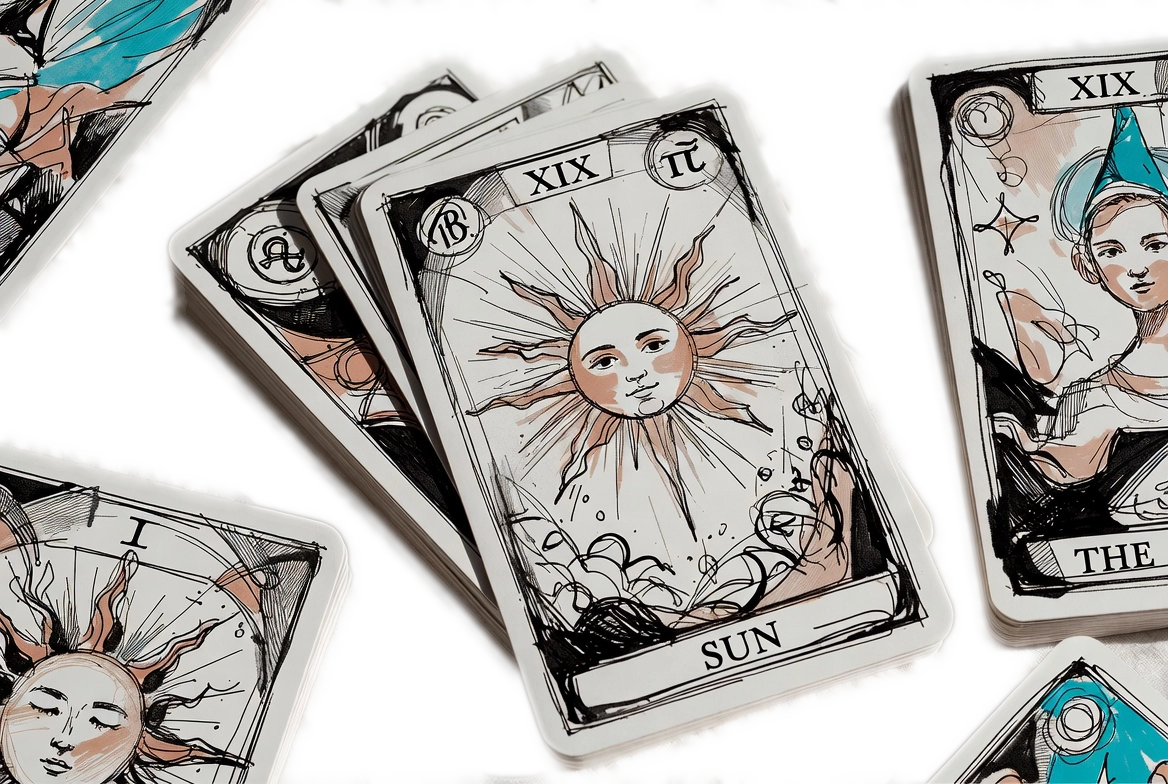
A tarot deck is seventy-eight cards. That number is worth sitting with for a moment, because the structure itself is a kind of map of a human life, and the structure is the part most people never look at.
The seventy-eight split into two groups. Twenty-two of them are the Major Arcana, and fifty-six are the Minor Arcana. The word Arcana simply means secrets, or mysteries, from the Latin arcanum. Major and Minor are not a ranking of importance. They are a distinction of register, of scale. The Major cards speak in the language of the big passages, the great chapters. The Minor cards speak in the language of ordinary Tuesdays.
The twenty-two Major Arcana are numbered from zero, which is The Fool, all the way through twenty-one, which is The World. They carry the archetypal images you have probably seen even if you have never touched a deck: The Lovers, The Tower, Death, The Star, The Hermit. These are the figures of myth and dream, the shapes that show up across cultures because they are shapes that show up across human lives.
The fifty-six Minor Arcana are organized the way a regular deck of playing cards is, which is no accident, as you will see in a moment. There are four suits of fourteen cards each. Each suit runs from Ace through Ten, and then has four court cards: a Page, a Knight, a Queen, and a King. Fourteen cards times four suits is fifty-six. The Minors are where daily life gets its texture, the small choices and tensions and satisfactions that the big archetypes never quite touch.
I want you to notice something about that architecture before we go further. Twenty-two great passages, and fifty-six threads of ordinary living. That is roughly the proportion of an actual life. The huge turning points are rare. The daily weave is constant. Whoever shaped this deck, and we will get to who that was, built something that mirrors the grain of being a person. That is the part I respect, entirely apart from any mysticism.
The Fool's Journey
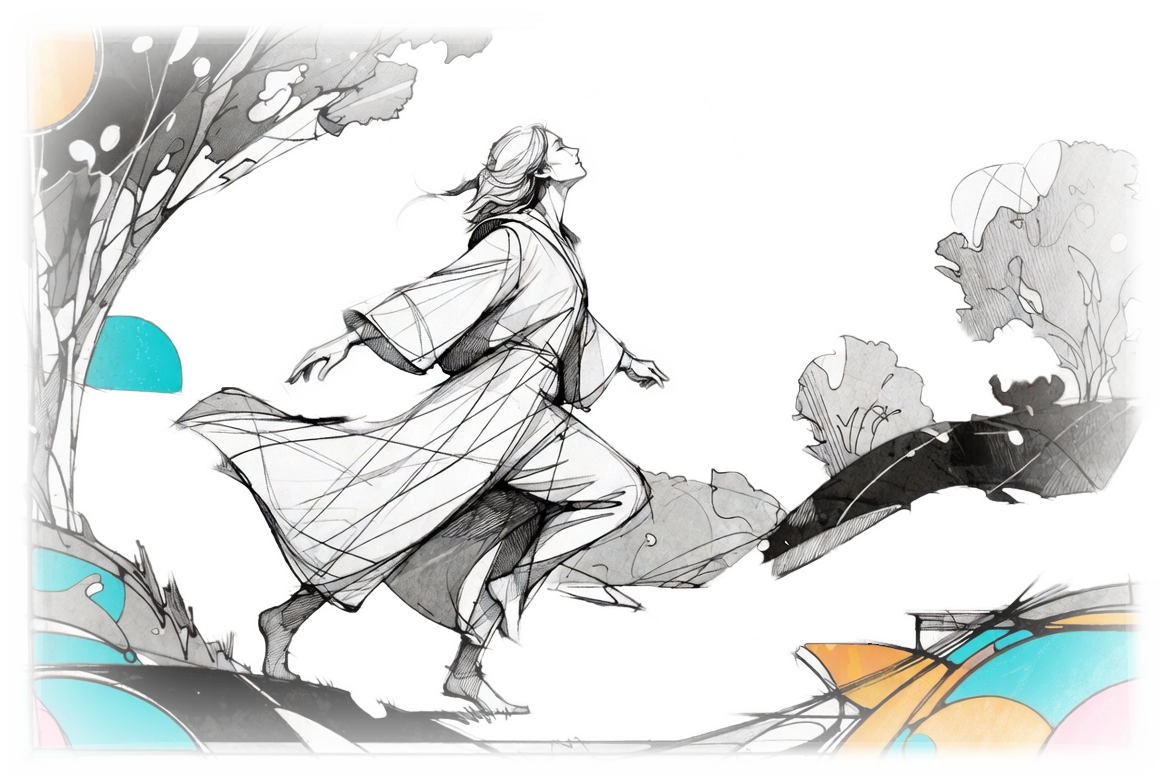
The twenty-two Major Arcana are most often read as a sequence, a story sometimes called the Fool's Journey. The Fool is card zero, the figure stepping off a cliff with everything he owns in a small bundle, looking up at the sky instead of down at his feet. He is innocence, beginning, the not-yet-shaped self. And the twenty-one cards that follow him are read as the great stages he passes through on the way to becoming whole.
He meets The Magician and The High Priestess, the active and receptive ways of knowing. He encounters The Lovers, which is far less about romance than about the first real choice, the moment you have to decide what you are for. He meets The Hermit, who carries a lantern alone, the season of turning inward. He passes through the difficult cards too: The Tower, where a false structure comes down, and Death, which I will say very plainly does not mean physical death. It means an ending, a transition, a chapter closing so another can open. The card panic people feel when they turn over Death is a misreading of the entire symbolic register. It is the card of necessary change.
I do not read the Fool's Journey as a schedule. Nobody walks it in order, and you do not get a card a year like a calendar. I read it as a vocabulary. It is a set of words for life stages that most languages do not give us cleanly. We have no everyday word for the season of necessary collapse, or the season of patient solitude, or the moment of integration where the parts of you finally cooperate. The Major Arcana hand you those words. And when you finally have a word for the thing you are inside, you stop feeling crazy and start feeling located. That alone has value.
The Four Suits and the Weave of Ordinary Days
The Minor Arcana, those fifty-six cards, divide into four suits, and each suit is associated with one of the classical elements. This is the daily-life register, the texture I keep returning to.
Wands are fire. They are action, drive, creativity, the spark of wanting to do something and the energy to do it. When your Wands are alive, you are building. When they are scattered, you are burning out or stalling.
Cups are water. They are emotion, relationship, love, grief, the whole tidal life of feeling. Cups are where the heart keeps its weather.
Swords are air. They are thought, the mind, clarity and conflict, the cutting edge of an idea and the wound of a worry. Swords are often the hardest suit because the mind is where so much of our suffering gets manufactured and rehearsed.
Pentacles, sometimes called Coins, are earth. They are work, money, the material world, and the body. Pentacles are about what is solid: your health, your craft, what you can actually hold in your hands.
Notice that the four suits together cover the entire surface of an ordinary life. What you are doing, what you are feeling, what you are thinking, and what you are building or tending in the physical world. Fire, water, air, earth. There is nowhere else for a daily concern to live. That is the genius of the structure, and again it has nothing to do with magic. It is a complete inventory of where a human being can be pinched or fed on any given day.
The court cards, the Pages, Knights, Queens and Kings of each suit, are usually read as people, or as ways of carrying that suit's energy. The Page is the student of the element, curious and unformed. The Knight is the element in motion, sometimes to excess. The Queen holds the element inwardly with mastery. The King expresses it outwardly with authority. They give the Minors a human face, so that fire is not just fire but a fiery person, or the fiery way you yourself are showing up this week.
Where Tarot Actually Came From
Now I have to be honest with you about history, because honesty is the whole foundation of how I work, and there is a beautiful lie wrapped around tarot that I will not pass along.
Tarot did not come from ancient Egypt. It did not come from the Romani people, and it was not handed down from some unbroken thread of Kabbalistic priests. Those stories are lovely, and they are false. Here is what genuinely happened, as far as the historical record shows.
Tarot began in fifteenth-century Italy, in the 1430s and 1440s, as a card game. Someone took an ordinary four-suit deck of playing cards, the ancestor of the deck you might keep in a drawer, and added a fifth suit of trump cards, called trionfi, which means triumphs, plus a single Fool card. That fifth suit of triumphs is what became the Major Arcana. The earliest luxury survivors we have are the Visconti-Sforza decks, painted around the 1450s for aristocratic families in Milan. They were hand-painted treasures for the wealthy, used to play a trick-taking game something like bridge. There is no evidence anyone used them to tell fortunes. For its first three hundred and fifty years, tarot was a game.
The divination story arrives surprisingly late. Around 1780, in France, occult writers including a man named Antoine Court de Gebelin decided the cards must hold ancient Egyptian secret wisdom, and they attached that origin myth to a game that was, by then, a few hundred years old. It was a romantic invention dressed up as scholarship. The famous deck most people picture today, with its full illustrated scenes on every card, is the Rider-Waite-Smith deck from 1909, illustrated by an artist named Pamela Colman Smith, whose name deserves to be said because her images shaped how the whole modern world reads tarot.
I tell you all of this not to deflate the thing, but because I have a deep conviction about how to honor a tradition. I do not rely on labels. I honor their intention. And the intention of tarot, even as a game, was always to lay out the whole human drama in a deck you could hold. A false Egyptian pedigree does not make it more useful. The truth makes it more trustworthy, because now we know exactly what it is, and we can use it for precisely what it is good at.
The Mechanism of the Mirror
So if the cards are not magic, why do they so often land with such uncanny precision? Why does the card you turn over so frequently seem to be about exactly the thing you are wrestling with?
The answer is not in the card. The answer is in you, and it is one of the most reliable features of being human. It is called projection, and it is not a flaw. It is how meaning works.
When you look at an ambiguous image, your mind cannot leave it ambiguous. It reaches in and completes the picture using whatever is most alive in you right now. Show ten people the Three of Swords, a heart pierced by three blades, and you will get ten different stories, and every one of them will be true, because every one of them is a confession of what that person is carrying. The person fresh from a betrayal sees betrayal. The person bracing for a hard conversation sees the conversation. The card did not know any of that. The card is just a heart and three swords. The meaning came out of the viewer.
This is why the ambiguity is the feature, not the bug. A precise image, a photograph, gives you nothing to project onto. But a symbolic image with just enough room in it pulls your half-formed feeling up into the light and gives it a shape. And once a feeling has a shape, you can finally name it. Naming is the whole event. You walk around for weeks with a vague heaviness, and then you turn over a card and hear yourself say, out loud, the exact sentence you had been refusing to say. The card did not put that sentence in you. It created the conditions for you to find it.
I see the same mechanism in the bodywork room every day. I do not put insight into anyone. I create a condition, a quality of attention and safety, in which the person's own knowing can surface. The card is doing the same job in a different medium. It is a permission structure for self-honesty.
Reflection, Not Fortune-Telling
I want to draw the ethical line very clearly, once, and then trust you with it, because I think you can hold it.
Tarot reflects. It does not predict. It is a tool for self-understanding, a structured way to externalize a question and hear your own answer. It is not medical advice, not psychological diagnosis, not financial guidance, and it is not a window into events that have not happened. No card binds anything. Even the traditionally difficult ones, The Tower, the Three of Swords, the Ten of Swords, are invitations to look at something, never verdicts handed down. If you turn over a hard card, nothing has been decided about your life. You have simply been handed a doorway, and you get to choose whether to walk through it and look.
The moment tarot becomes dangerous is the moment you hand it your agency. The moment you say, the cards told me to leave him, or the cards told me it will all work out, you have stopped using a mirror and started using an oracle, and an oracle is a way of avoiding the responsibility of your own choice. I will not help anyone do that. A responsible reading frames everything as reflection and possibility. It returns you to your own authorship. It says: here is what stirred in you when you looked. Now what will you do with that knowing? The cards never decide. You decide. They just help you hear yourself decide.
Held that way, with zero supernatural claims, tarot loses nothing. Its entire value was always psychological and reflective. It is a disciplined practice of asking a question, externalizing it, and listening for your own response. That holds up under the brightest skeptical light, which is exactly why I am comfortable putting it in your Human Map.
Your Birth Card
Inside the Human Map, tarot shows up in a few specific and gentle ways. The first is your birth card, a single Major Arcana archetype calculated from your date of birth that stays with you for life.
The method is simple arithmetic. You take your full birth date and break it into the month, the day, and the year split into its two two-digit halves. You add those numbers together, and then you keep summing the digits until you arrive at a number twenty-two or below, which lands you on one of the Major Arcana.
Let me walk one through so it is concrete. Suppose a birthday of June 28, 1991. You take 06 for the month, 28 for the day, and split the year into 19 and 91. Add them: 06 plus 28 plus 19 plus 91 equals 144. Now reduce: 1 plus 4 plus 4 equals 9, which is The Hermit. And because 144 also reduces through the two-digit step, the paired card is 18, which is The Moon. So this person carries The Hermit and The Moon together, the lantern-bearing solitary seeker paired with the card of intuition, dream, and the unlit places. Most people end up with a pair like this, a two-digit card and its single-digit reduction, two facing aspects of one lifelong theme.
Here is the part I need you to hear. Your birth card is not a label stamped on your forehead, and it is certainly not a personality cage or a schedule of events. It is a recurring question. It is the archetypal theme that, in my experience, keeps knocking on a person's door across the decades, the lesson the life keeps offering in new costumes. The Hermit person keeps being asked, in season after season, what they know in solitude that they cannot know in the crowd. The card does not make that happen. It just names a pattern you may recognize once it is pointed out. And recognizing a lifelong question is a quiet relief, because it tells you the thing you keep circling back to is not a failure to move on. It is your particular work.
Your Year Card and the Monthly Three
The birth card is fixed. But a life is not one note, it moves through chapters, so the Human Map gives you two rotating reflections alongside the fixed one.
The first is your year card. It uses the very same reduction, except you swap your birth year for the current year. So it is your birth month, plus your birth day, plus the two halves of this year, reduced down to a Major Arcana card. Because the year changes, this card changes annually. I think of it as the flavor of the chapter you are standing in right now. It is not a prediction of what the year will bring. It is a lens for the season you are in, an invitation to ask: if this archetype were the theme of my year, what in my life is it pointing me toward? Some years the card lands and you feel it immediately. Some years it sits quietly and only makes sense in hindsight. Both are fine. It is a prompt, not a forecast.
The second rotating piece is smaller and more frequent: a monthly three-card reflection. Three cards drawn as a low-stakes prompt for the present moment, nothing heavy, nothing binding. I keep these deliberately light. A monthly three is not a major reading. It is closer to a single good journaling question, the kind that gets you to sit down and notice where you actually are before the month carries you off in its current. You look at the three images, you let them pull something up, and you write down what surfaced. That is the whole ceremony.
All three, the fixed birth card, the rotating year card, and the monthly three, are framed the same way in your Map: as reflection, never prediction. They are mirrors at three different distances. One for your whole life, one for your current chapter, one for this passing month.
The Quieter Knowing
If you take only one idea from all of this, let it be this one, because it is the thing I most want you to understand about why a deck of fifteenth-century Italian game cards can still be worth your time.
A tarot card predicts nothing and decides nothing. What it does is stranger and, I think, more valuable. It is an ambiguous mirror that asks you a sharper question than you would ever ask yourself, and then, because the image is open enough to receive your projection, it lets you pour your own meaning into it. And in that pouring, you finally say out loud what a quieter part of you already knew and had been keeping just below the surface of attention.
This is why the cards feel uncanny. They are not reading you. They are giving you a clean surface to read yourself against. The truth you find in a reading was never in the card. It was in you the whole time, half-formed, waiting for a shape and a moment and a little permission. The card is the doorway. You are the room behind it.
I find a deep tenderness in that. So much of the work I do is helping people stop waiting for an authority outside themselves to hand them their own knowing. The internal GPS, the True Self that lives only in the present moment, the part of you that quietly knows the next true thing, is almost always already aware of the answer. It is the future-living Survivor Self, busy planning and scanning and protecting, that talks over it. A card, used honestly, is a way of asking the planner to be quiet for a minute so the knower can speak.
How to Sit With a Card Honestly
Let me leave you with a practice, because understanding is one thing and doing is another, and this is genuinely something you can try this week with nothing but a single card and a few quiet minutes. It is skeptic-friendly. You do not have to believe anything for it to work, because the work is being done by your own attention, not by the card.
- First, ask the real question before you look at anything. Not the polite question, the real one. Not should I take the job, but what am I afraid will happen if I stay where I am. Get the question honest and specific. The sharper the question, the more honest the mirror.
- Second, draw one card, or look at your year card in the Map, and do not rush to its dictionary meaning. Look at the image first. Notice what your eye goes to, what feeling rises, what story your mind reaches for before you have read a single word about what the card officially means. That first uninvited reaction is the projection, and the projection is the gold.
- Third, write down what surfaced. The actual sentence. The thing you said in your head when you saw the image. This is the part most people skip, and it is the only part that lasts. The insight that stays unwritten evaporates by morning.
- Fourth, and this is the discipline that keeps it honest: discard the rest. Keep the one true thing the card surfaced and let go of any sense that the card has decided something or promised something. If it surfaced nothing real, draw a line through it and move on with no superstition attached. The card owes you nothing and binds you to nothing.
And then, before you go look anything up, you might bring it into the body, because I am a bodyworker and I cannot help myself. Take the feeling that surfaced and ask where it lives in you. Not what you think about it. What does the sensation actually feel like, and where. A tightness in the throat. A weight low in the belly. A held breath you did not notice you were holding. The mind will argue about the card forever. The body tends to tell the truth faster.
That is all it is. A question, a mirror, a sentence you finally let yourself write down, and the rest released. No prophecy, no fate, no surrendering of your own authorship. Just a small, disciplined way of hearing yourself more clearly. I facilitate, I do not force, and a card cannot force anything either. It can only create the conditions for you to say the quiet thing out loud. What you do once you have heard it has always been, and will always be, entirely yours.
See this in your own Map
Reading about tarot in general is one thing. Reading your own is another. If you have a Human Map, open your Tarot section to see how this lens reads your birth moment. New to the Human Map? Start here.
A note on how to hold this. Your Human Map is a set of reflective tools for self-understanding and contemplation, drawn from many wisdom and symbolic traditions. It is offered as education, not as medical, psychological, or financial advice, and nothing here diagnoses, treats, cures, or predicts. Wayne Noel is an integrative somatic practitioner, bodyworker and coach. He is also a California Certified Massage Therapist (CAMTC). The Human Map and the Capacity for Self Method are somatic and educational practices, not a substitute for licensed care. Take what genuinely serves you and leave the rest. Questions are always welcome through the contact page.
Ready to Start Your Healing Journey?
Book a session to experience integrative somatic coaching and bodywork tailored to your unique needs.